
Projects
Where does the energy of an electrical discharge go, and which reactions determine what it accomplishes? I study how a discharge can sustain a flame, change its transition to detonation, or transform a metal catalyst. Machine-learned molecular dynamics lets me examine the individual collisions and surface reactions behind these larger-scale processes.
From an electrical discharge to a sustained flame
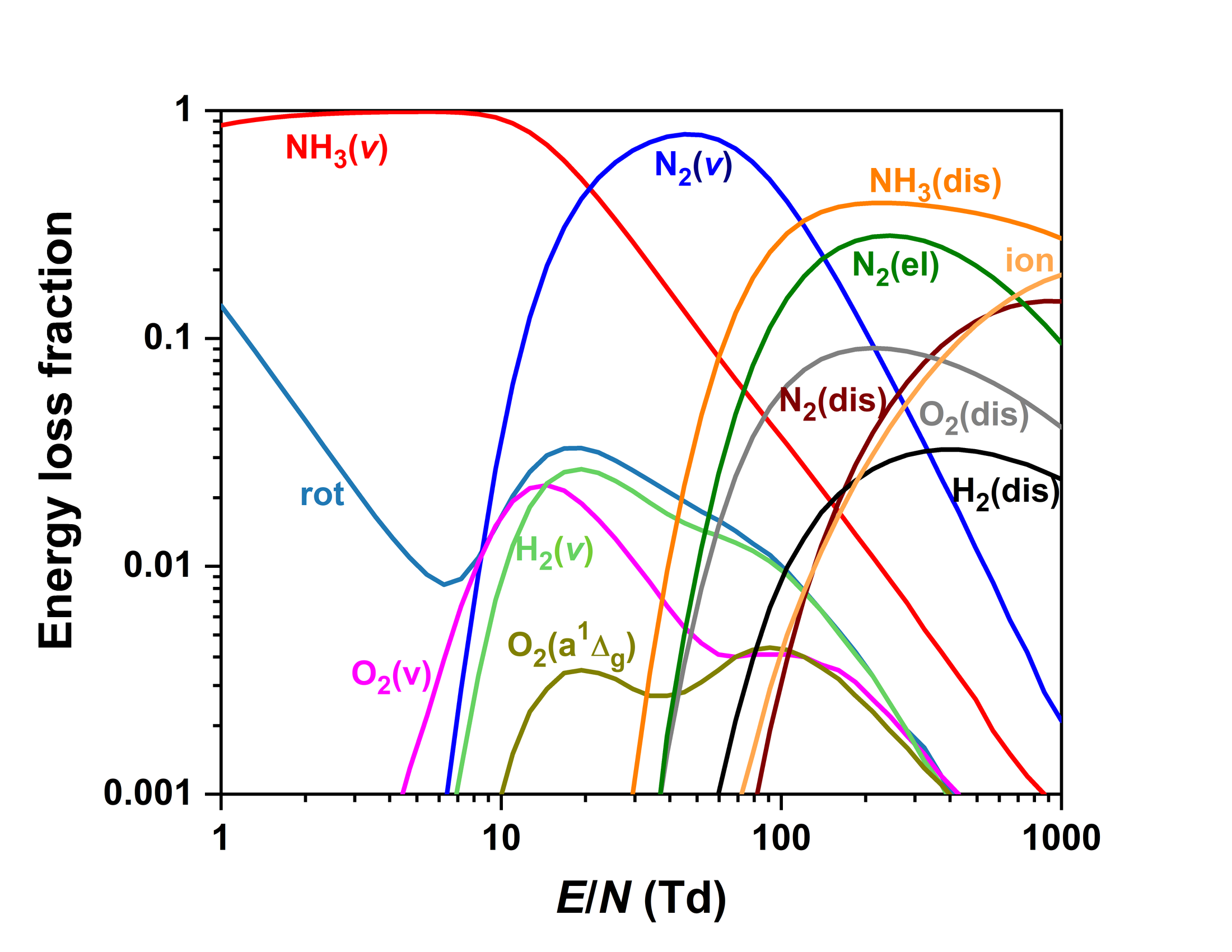
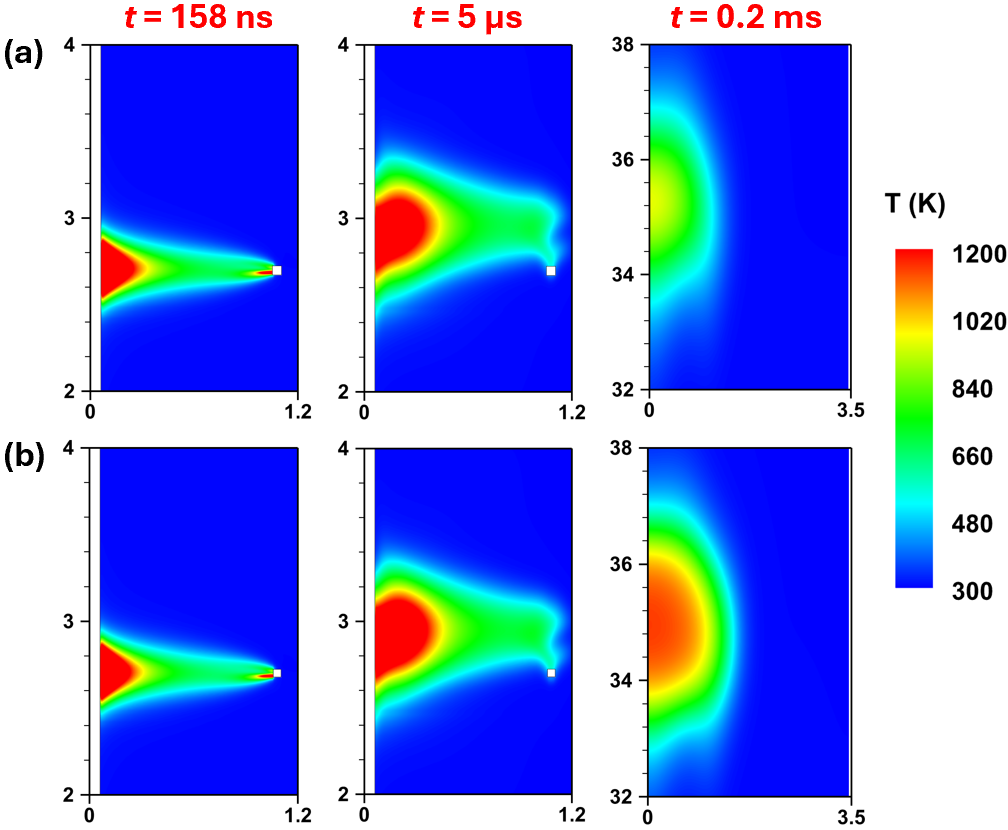
How can a nanosecond electrical pulse start a flame that survives long after the pulse ends? For fuels such as ammonia, slow ignition can limit their use in propulsion. I develop simulations that follow the energy deposited by a discharge from electron collisions with molecules to the growth of a flame in a moving gas.
In ammonia–hydrogen mixtures, I found that a stronger field can divert energy away from the molecular processes that favor ignition. In hydrogen–air, sustaining excitation between pulses lowered the energy needed to ignite the flows I studied. These results show why ignition design depends on which reactions a discharge excites and how long their effects persist.
Related publications
- Plasma assisted NH₃/H₂/air ignition in nanosecond discharges with non-equilibrium energy transferZ. Shi, X. Mao, Z. Wang & Y. Ju · Combustion and Flame (2025)
- Two-dimensional modeling of hybrid nanosecond pulsed and DC discharges for H₂/air ignitionShi, Z., Tsunoda, A., & Ju, Y. · Manuscript in preparation
- Kinetics of low temperature plasma assisted NH₃/H₂ oxidation in a nanosecond-pulsed dischargeN. Liu, B. Mei, X. Mao, Z. Wang, Z. Sun, Y. Xu, Z. Shi & Y. Ju · Proceedings of the Combustion Institute (2024)
When ignition triggers a detonation
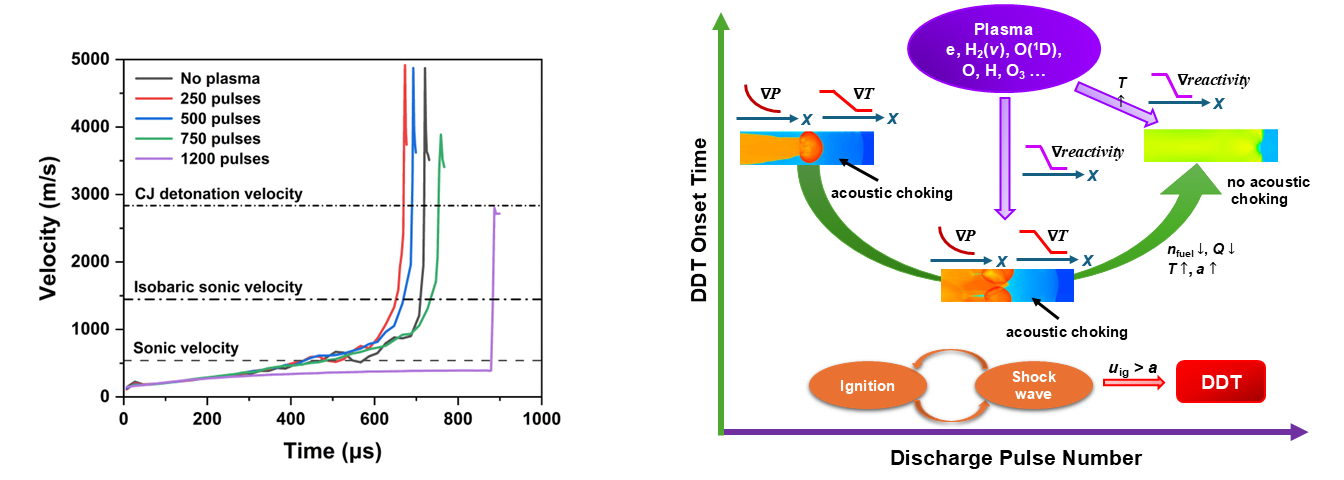
Once a flame takes hold, the location and timing of the next ignition event can determine whether a shock and a reaction front join to form a detonation. That transition is desirable in detonation engines and dangerous in fuel-handling equipment. My hydrogen–oxygen simulations showed why a plasma can steer it in either direction. A discharge can hasten local ignition yet consume enough fuel ahead of the flame to delay detonation. Predicting the outcome requires following how chemical energy reinforces the shock.
In companion experiments on dimethyl ether led by Madeline Vorenkamp, our team used laser diagnostics and high-speed imaging to probe the role of low-temperature chemistry. In related work with Andy Thawko, we showed how ozone accelerates the coupling between ignition and a shock. Together, these studies show how reactions ahead of a flame can strengthen or weaken its coupling to a shock.
Related publications
- Numerical modeling of plasma assisted deflagration to detonation transition in a microscale channelZ. Shi, X. Mao, A. Thawko & Y. Ju · Proceedings of the Combustion Institute (2024)
- Effect of plasma-enhanced low-temperature chemistry on deflagration-to-detonation transition in a microchannelM. Vorenkamp, S. Steinmetz, X. Mao, Z. Shi, A. Starikovskiy, Y. Ju & C. Kliewer · AIAA Journal (2023)
- Accelerated ignition-shock coupling and deflagration to detonation transition by ozone kinetic enhancement of dimethyl ether mixtureA. Thawko, Y. Cao, Z. Shi, M. Vorenkamp, Z. Wang, B. Mei, X. Mao & Y. Ju · Proceedings of the Combustion Institute (2024)
When a plasma changes the catalyst itself
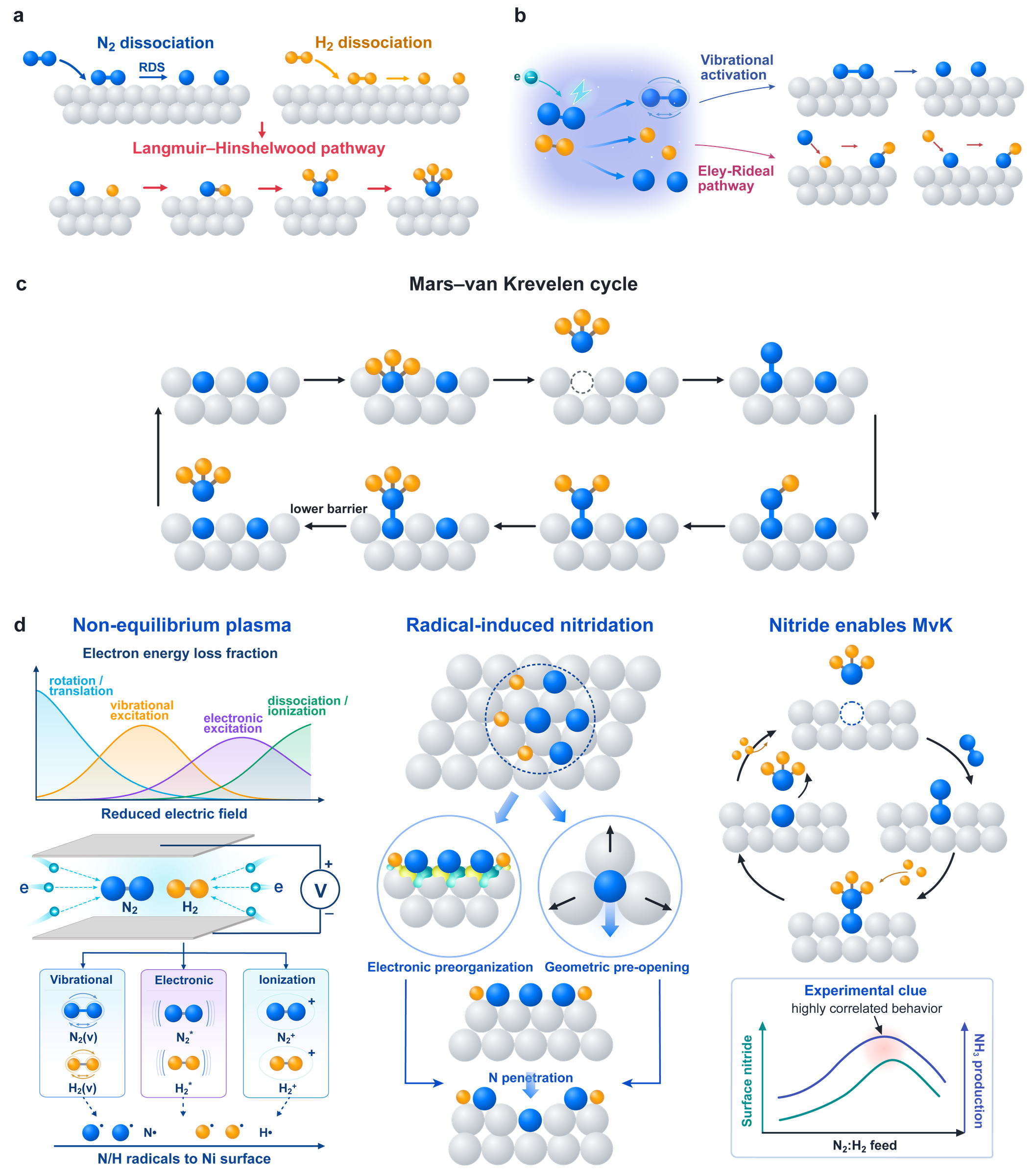
A discharge can reshape chemistry at a solid surface as well as in a flowing gas. In ammonia synthesis, that raises a fundamental design question. What if the plasma changes the identity of the working catalyst and opens a reaction pathway that the original metal could not sustain?
Experiments found that adding hydrogen to a nitrogen plasma could increase nitrogen uptake by nickel, even as less atomic nitrogen was available in the gas. Working with Yiteng Zheng and colleagues, I used plasma kinetics and density functional theory to explain this reversal. Hydrogen adsorbed on the surface helps nitrogen enter the metal. The resulting nitride could itself supply nitrogen for ammonia formation through a Mars–van Krevelen cycle. This suggests a way to tune the working catalyst during operation through the composition of the discharge.
Related publications
- Plasma-generated radicals induce nickel surface nitridation for ammonia synthesisShi, Z., Lele, A., Zheng, Y., Kondratowicz, C., Fu, G., Koel, B. E., & Ju, Y. · Manuscript in preparation
- Unraveling in-situ formation of surface nickel nitride structures in plasma-assisted catalytic ammonia synthesisC. Kondratowicz, Y. Zheng and colleagues · The Journal of Physical Chemistry Letters (2026) · Companion experiment
- Unraveling nonequilibrium generation of atomic nitrogen and hydrogen in plasma-aided ammonia synthesisN. Liu, X. Mao, C. Kondratowicz, T. Y. Chen, B. Mei, Z. Wang, Y. Xu, H. Zhong, Z. Shi, A. Morozov, A. Dogariu & Y. Ju · ACS Energy Letters (2024)
Learning reaction dynamics from molecular collisions
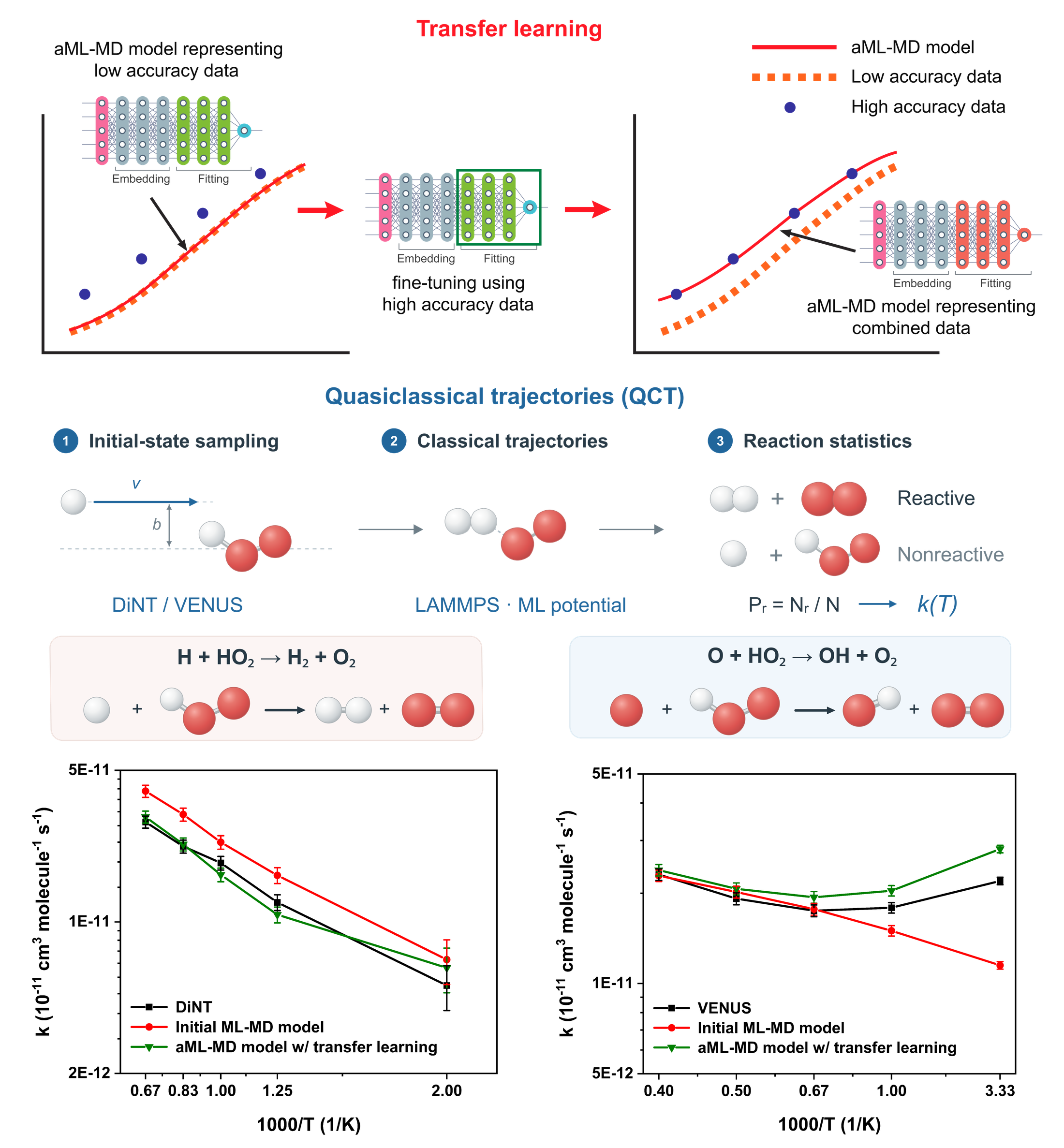
Models of flames and catalysts depend on rate constants. Each one represents the outcome of countless molecular encounters, only a fraction of which form a new bond. I train interatomic potentials on quantum calculations so that enough of these encounters can be simulated to predict rates directly. For a benchmark reaction in hydrogen combustion, combining two levels of quantum chemistry reproduced the reference rates while cutting the cost of generating training data by more than 80%.
With Argonne collaborators, I have extended this approach to collisions that redistribute energy as well as those that form new products. With Aditya Lele and colleagues, I helped develop a force field to follow ammonia synthesis on iron under temperature modulation. These studies connect the motion of individual atoms to the reaction data that larger-scale models need.
Related publications
- Quasi-classical trajectory calculation of rate constants using an ab initio trained machine learning model (aML-MD) with multifidelity dataZ. Shi, A. D. Lele, A. W. Jasper, S. J. Klippenstein & Y. Ju · The Journal of Physical Chemistry A (2024)
- Ab Initio-Trained Machine Learning Molecular Dynamics Model for Radical Reactions in Hydrogen CombustionZ. Shi, A. D. Lele, A. W. Jasper, S. J. Klippenstein & Y. Ju · AIAA SciTech Forum (2026) · Conference paper
- Machine-learned force field for molecular dynamics simulations of nonequilibrium ammonia synthesis on iron catalystsA. D. Lele, Z. Shi, S. Khetan, E. A. Carter, J. M. P. Martirez & Y. Ju · The Journal of Physical Chemistry C (2025)
- A unified ab initio-trained machine learning potential for quantitative reaction dynamics of HO₂ + R radical reactions in hydrogen combustionShi, Z., Lele, A., Jasper, A. W., Klippenstein, S. J., & Ju, Y. · Manuscript in preparation
- Ab initio-trained machine learning molecular dynamics for collisional energy transfer in HO₂ + M third-body reactionsShi, Z., Lele, A., Jasper, A. W., Klippenstein, S. J., & Ju, Y. · Manuscript in preparation